Resilience is increasingly one of the most widely used concepts in disaster work, yet it is defined differently across disciplines, sometimes in direct tension. This presentation traces resilience from its origins through its history and application, drawing on Dr. da Rosa’s research on the 2020 Labor Day Fire recovery efforts and the Disaster Resilience Learning Network’s (DRLN) approach to building disaster resilience and recovery within their communities. It examines how resilience is understood as both a process and an outcome, and how its neoliberalization has shifted responsibility onto individuals and communities. The result can look like an abundance of resources while delivering uneven impact for survivors. The presentation then turns to the Network’s expanded definition of disasters, which recognizes that disasters are cyclical, chronic, and compounding rather than linear, and that historical trauma and legacies of subjugation continue to shape their impact. Transformational resilience approaches this expanded definition of disasters as structural and inclusive of political and structural problems that surround any single event, and the scope of resilience itself. The presentation highlights the work of DRLN CBOs in reclaiming resilience and situating it locally by shifting decision-making, using cultural lenses to understand resources, and giving up power.
Unraveling Resilience in its Origins, Legacy, & Reclamation
- Friday, Oct 23
- 12:30 pm –
- Great Hall
About this session
Hosted by
Moderated by

I am an Assistant Professor at the School of Social Work at Portland State University, housed at Trauma Informed Oregon. I started my career in social work through volunteering with BSW social workers to work with children in emergency shelters and later received my MSW at the University of Maine. In my role I work with community based organizations to apply trauma informed approaches for both those served and the workforce through evaluation, integration, and advocacy. My primary focus is the intersection of cultural resources, race, climate change, and disaster resilience. With the rise in frequency and severity of climate disasters, I collaborate, evaluate, and consulate statewide networking with BIPOC focused community based organizations to support staff and community wellbeing with a trauma informed lens. I am passionate about anti-racist, trauma informed care because it focuses on organizational change to prevent and resist retraumatization for both community members and staff, inviting everyone into places of decision making.
Since 2021 and in response to the 2020 Labor Day Fires, I supported the formation and continue to support what is now the Disaster Resilience Learning Network (DRLN), a network for and by community-based organizations of color. In this network, we problematize resilience to unlearn neoliberalist influences in how resilience is conceptualized and reclaim its practice within culture, language, and community.
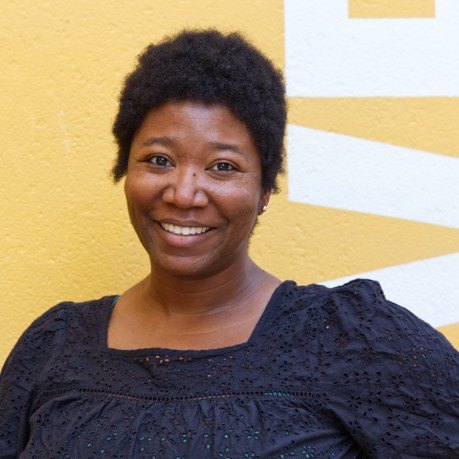
Jamila K. Wilson began her professional career as an Americorps volunteer after graduating from the University of Missouri – Columbia with a BA in Political Science in 2001. In 2022 Jamila joined United Way of the Columbia Willamette and currently serves as the Director of the Climate and Disaster Resilience dept. In this role she stewards the Disaster Resilience Learning Network (DRLN), a network of leaders of color advancing equity and cultural practices as tools of resilience in disaster and emergency management.
Jamila’s passion for investing in human capital is rooted in the global liberation movements of the 19th and 20th centuries, “I believe in democracy for and by the people. The people must be confident in their innate leadership abilities and strive to restore a harmonious relationship with the planet and all of her inhabitants.
 EN
 ES